Built for ports · full-scenario safety operationsintelligent assistant
8
Business Domains
2269
Knowledge Entries
23
Graph Entities
4
Industry Instances
OVERVIEW
An industry vertical LLM built for port safety
Built on an "industry-agnostic engine + swappable industry instances" architecture, one engine drives four instances: ports, chemicals, senior care and Hong Kong education. The port instance covers the full scope of port safety operations across eight domains — risk classification and control, hazard inspection and remediation, safety training, regulations and standards, standardization, emergency management and accident cases — layered with knowledge graphs, scenario-based risk simulation, offline private deployment and blockchain notarization. Aligned with GB/Z 239-2026 "AI - Technical Requirements for Port Large Models" — the national standard.
CORE CAPABILITIES
Eight business domains · full coverage
01
Risk Classification
60 work units, 204 risk events, four-dimensional quantitative assessment (people / machine / environment / management). High-risk units are surfaced automatically.
02
Hazard Remediation
Reporting → automatic grading → remediation advice → follow-up registration → sign-off. A closed loop with built-in criteria for major hazards.
03
Safety Training
Knowledge study + online question generation + assessment. Scores are reported automatically, with a real-time pass-rate dashboard.
04
Regulations & Standards
Port Law, dangerous goods safety rules, GB/T 33000 and other regulatory libraries, with clause-to-record-form mapping.
05
Emergency Management
Hazardous chemical leaks, fire and explosion response, typhoon and flood preparedness, man-overboard rescue, plus plan drafting and drill essentials.
06
Accident Cases
59 typical port accidents (Tianjin 8·12, Qingdao 11·22, Yantian crane collapse and others), with cause analysis and preventive measures.
07
Work Permits & Special Operations
Online approval for six types of special work permits: hot work, confined space, working at height, lifting, temporary power and road closure. Pre-job safety briefing, supervisor confirmation, permit expiry reminders — the whole flow is logged and traceable.
08
Contractors & Related Parties
External crews are managed end to end: qualification review, safety agreement signing, induction training, on-site supervision and violation scoring. Responsibility boundaries stay clear and traceable.
>
ADVANCED
Four advanced capabilities
KNOWLEDGE GRAPH
Knowledge Graph · 23 entities across people, machines, vehicles, ships and cargo
Built on the "six categories, 23 core entities" framework, we built an entity-relationship graph for port safety: risks, relations and controls are one query away. Query "quay crane" and get ship-to-shore interface work, human-machine crossover and dropped-load hazards.
RISK SIMULATION
Scenario-Based Risk Simulation · quantitative
Based on a scenario-based risk simulation model. Covers four high-risk scenarios — human-machine crossover, ship-to-shore dangerous goods, hot work in confined space, and severe weather. Risk = likelihood × consequence, with automatic risk level and controls.
PRIVATE DEPLOY
Offline Private Deployment
The generation layer can switch to a local LLM (Ollama) and run entirely inside the intranet with no internet access. Data never leaves the network — essential for classified port and state-owned enterprise scenarios, and a market space that cloud-only offerings cannot reach.
BLOCKCHAIN
Blockchain Notarization
Scores, hazards and work permits are notarized on-chain (FISCO BCOS). Hash fingerprints are tamper-proof and permanently verifiable, forming a trustworthy closed loop for the entire safety process.
LIVE SCREENSHOTS
Real Running Interface
All screenshots below are from the actual running system — not mockups. The data comes from the real knowledge base and risk ledger.
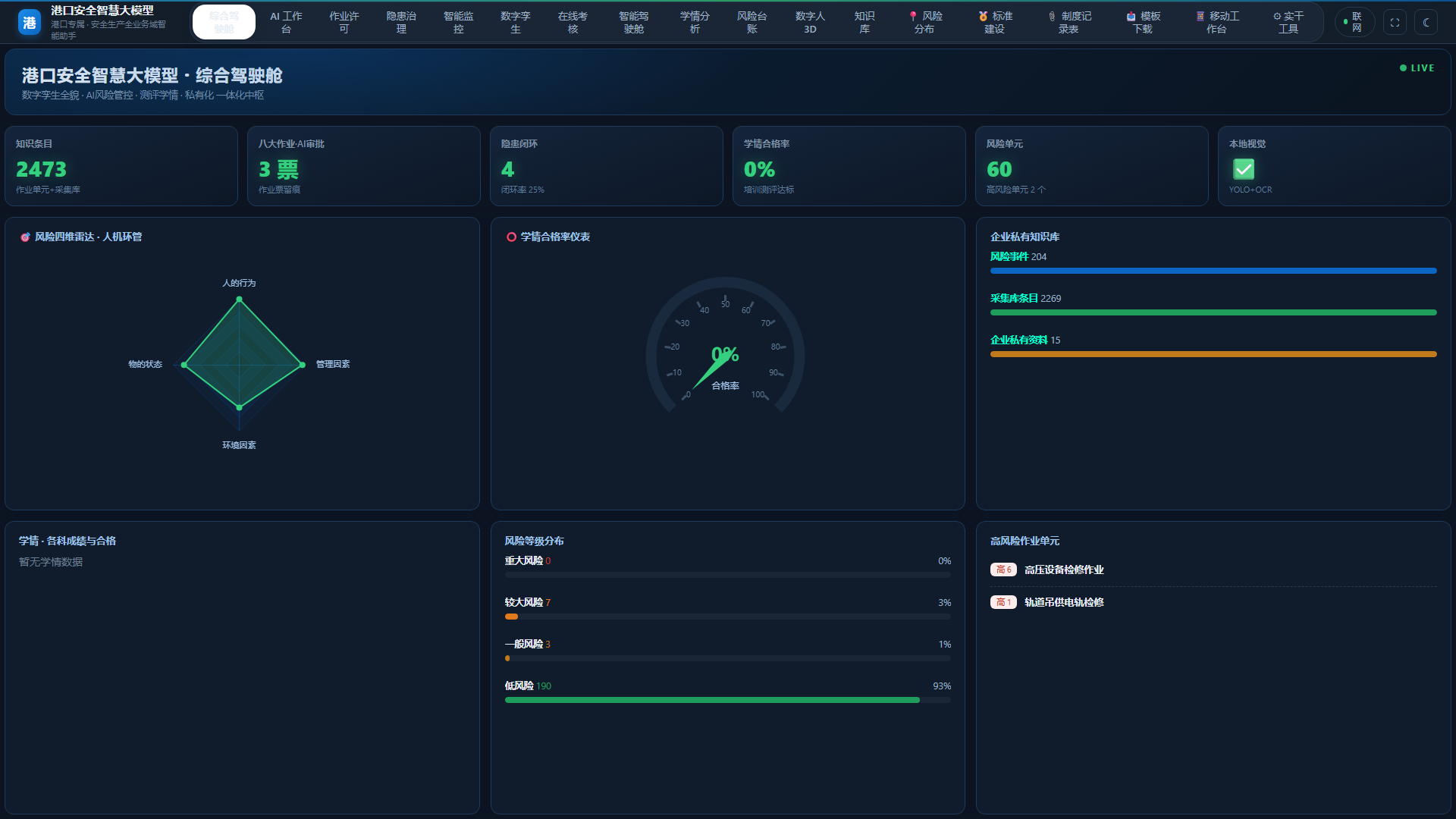
Unified Cockpit · Four-dimensional risk radar + knowledge / hazard-loop / risk-unit KPIs + learning dashboard + high-risk work units, in LIVE state
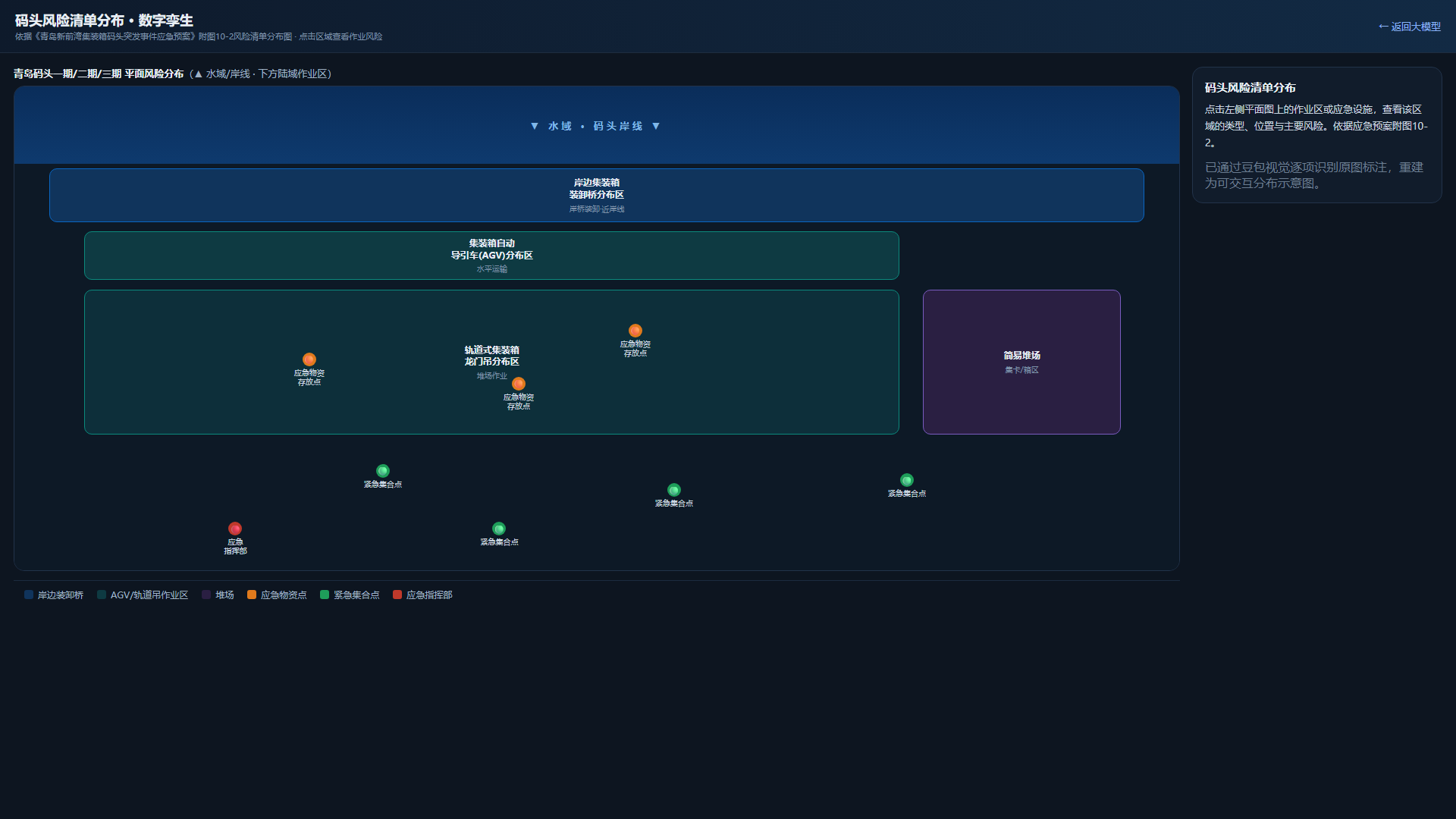
Terminal Risk Map · Digital Twin · Quay crane / AGV / rail-mounted gantry operating zones + spatial layout of emergency supplies, assembly points and command center
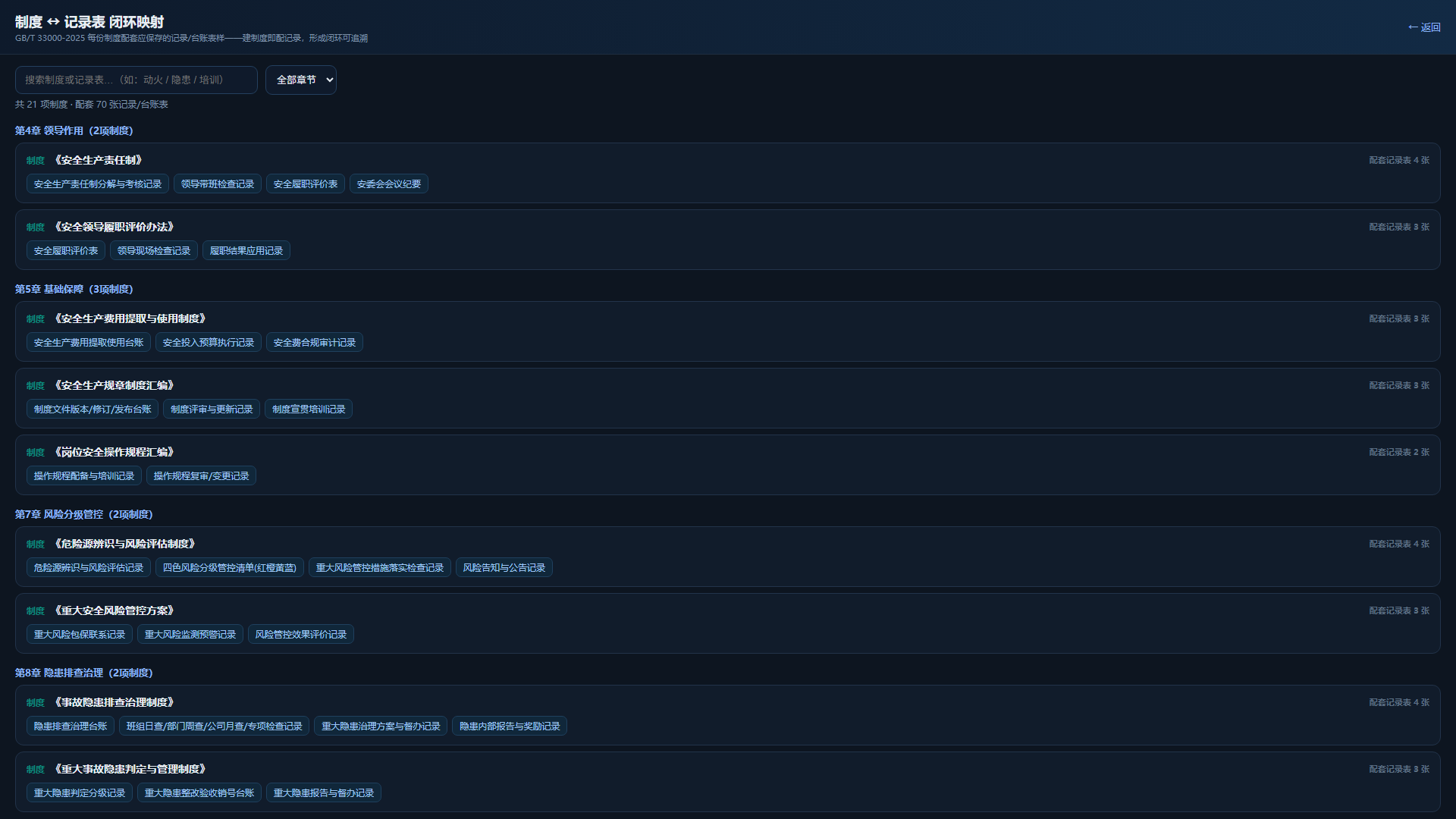
Clause-to-Record closed-loop mapping · 21 policies paired with 70 record and ledger forms — create a policy, get its forms
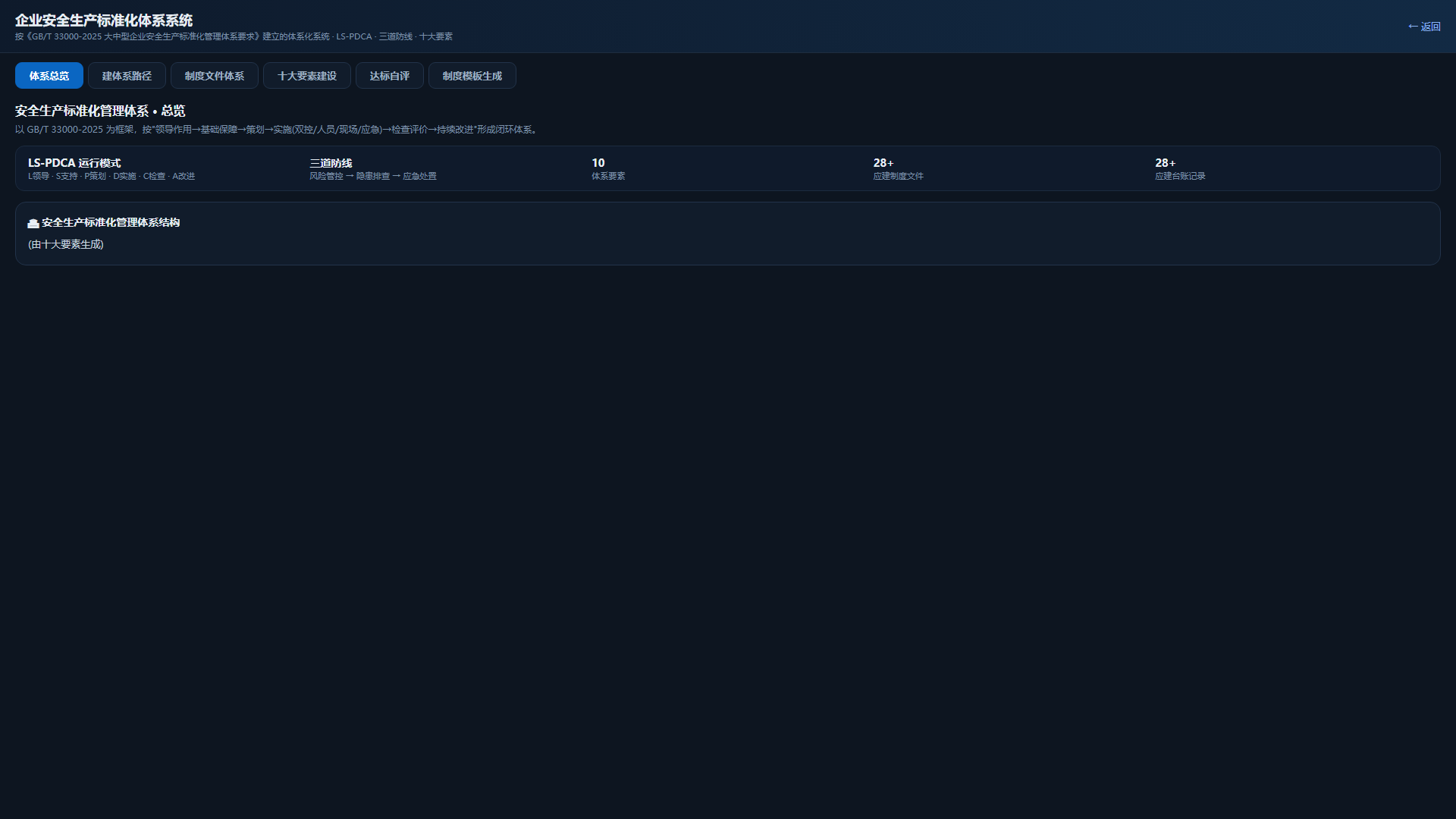
Standardization · Safety production standardization elements and clauses
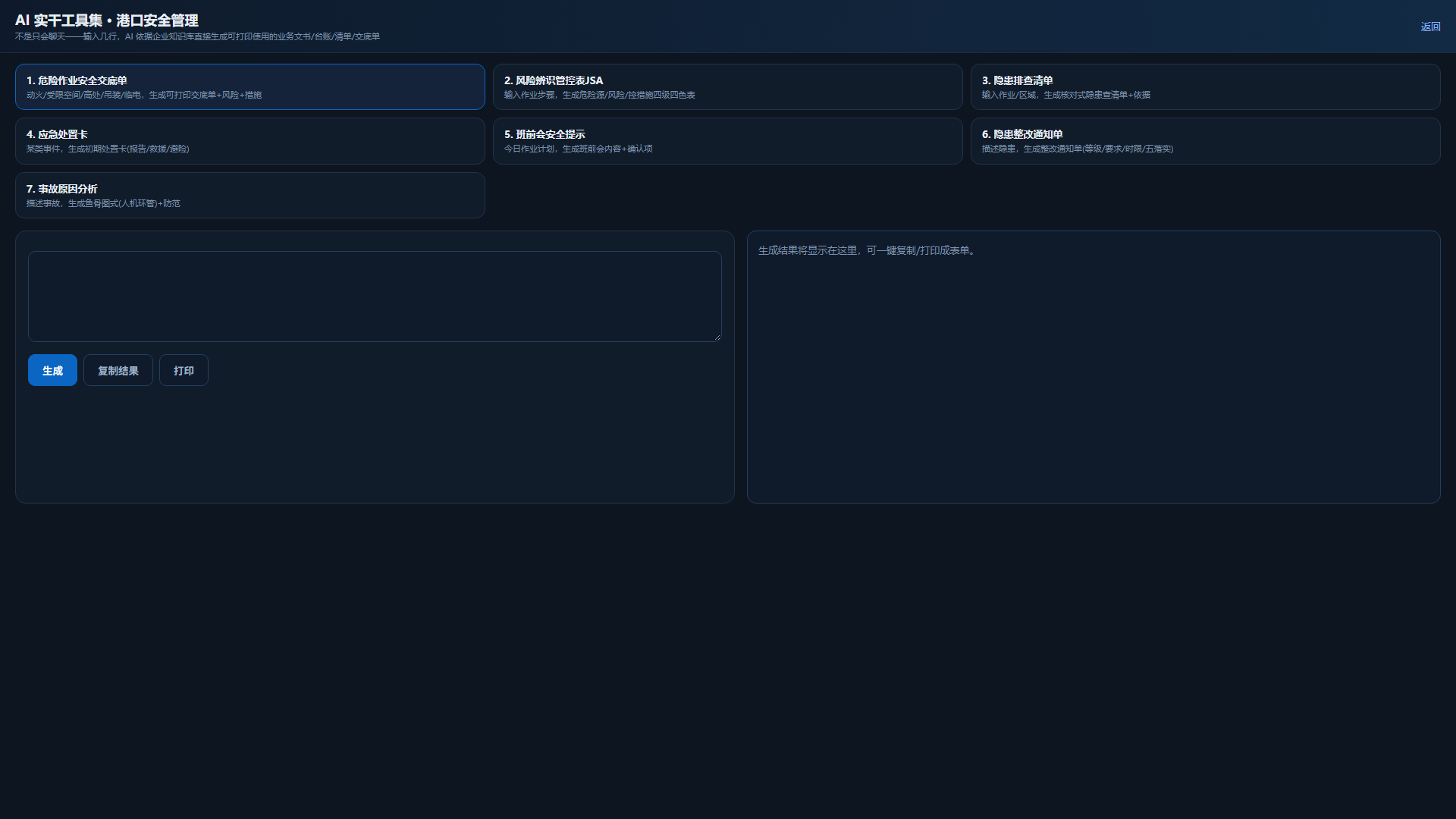
Field Tools · Front-line tools such as work permits and hazard reporting
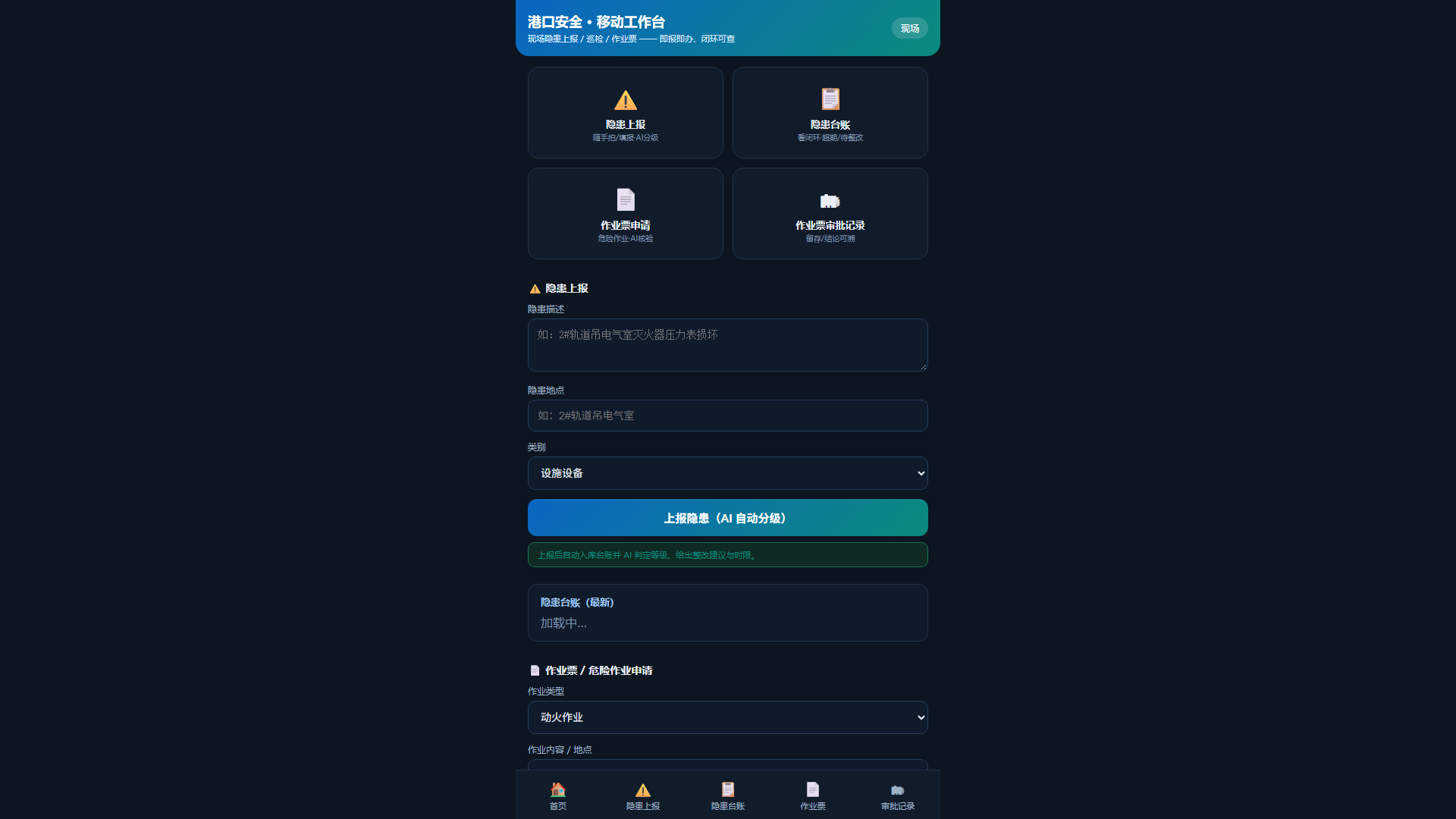
Mobile Workbench · Ask anytime, report on the spot from mobile
ADVANTAGES
What Sets Us Apart
Dimension
Typical approach
This product
Deployment
Cloud-only, needs public internet
Offline private deployment, runs in a pure intranet, affordable for SMEs
Notarization
Usually no blockchain notarization
FISCO BCOS Blockchain Notarization,成绩/隐患/作业票上链
Industry Extensibility
Custom-built for one industry
一引擎换 4 行业,边际成本极低
Data Volume
Relies on large corpora built over time
2,269 entries, with daily automated collection to keep closing the gap
Knowledge Graph
Recognition of the main entity types
23-entity relationship graph (aligned)
FAQ
Six things clients ask most about this product
Direct answers on what it does and where the boundaries are.
How is a port-safety vertical LLM different from a general LLM?
A general LLM doesn't understand ports. It doesn't know a quay crane from a rail-mounted gantry, doesn't know the risk points of ship-to-shore operations, and doesn't know the specific clauses in GB/T 33000 on hazard grading. Our port-safety vertical LLM turns 2,269 port safety knowledge entries (regulations, standards, accident cases, operating procedures) into a searchable knowledge base. Answers come with sources and can be verified.
How do you guarantee data security? Can it run offline?
Yes. The generation layer supports switching to a local LLM (Ollama), and the whole system runs in a pure intranet — no internet, no data leaving the network. This is essential for classified port and state-owned enterprise scenarios. Cloud-only offerings cannot do this.
Are 2,269 knowledge entries enough?
Frankly, we don't match the corpus volume built up by large institutions over years. But we measure "verifiable accuracy", not "entry count". The 2,269 entries are structured, sourced port safety knowledge covering eight domains, and daily automated collection keeps narrowing the gap. If what you need is answers you can look up, trace and trust — not invented ones — this is a workable starting point.
Is blockchain notarization mandatory?
Not mandatory, but very useful in safety production. Once scores, hazard records and work permits are on-chain, hash fingerprints are tamper-proof, so you can present on-chain proof directly during regulatory inspections and accident investigations. We use the FISCO BCOS consortium chain — no dependency on a public chain.
Can we buy only part of it — say just training and hazard modules?
Yes. The eight domains are modular — start with the two or three core ones, prove them out, then expand. We also support swapping industry instances: the same engine already drives ports, chemicals, senior care and Hong Kong education.
Do you have a system actually running? Can we see it?
Yes. The six screenshots on this page are from the actual running system — not mockups — with real knowledge base and risk ledger data. We can schedule an online demo and open the system for you directly.